Introduction: The Hidden Balance Sheet of Higher Education
Going to college in America today is just as much a financial challenge as it is an academic one. Undergraduates at major universities face a tough mix of heavy workloads, difficult classes, and skyrocketing tuition costs. While most conversations about the cost of college focus on the price of tuition, housing, and meal plans, the financial risk of academic failure usually goes ignored. Every single credit hour you take has a real dollar value, meaning your study time is a limited resource that needs to be budgeted like a business.
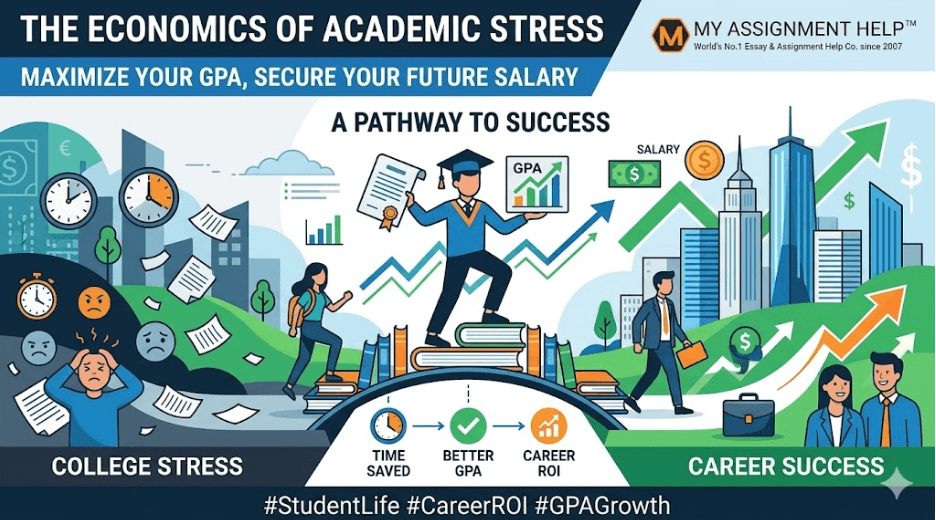
Academic stress isn’t just an emotional burden; it is a major financial drain. When you are completely overwhelmed by multiple research papers, intense lab assignments, and a job to pay the bills, your education stops paying off the way it should. Running out of time leads to simple mistakes, dropping grades, missed internship opportunities, and an increased risk of failing or dropping a class. In this high-pressure environment, using academic support services is no longer just a luxury—it is a smart strategy to protect your hard work. By treating your study hours as an investment, you can figure out the real Return on Investment (ROI) of getting extra help when you need it.
Navigating the complex technical requirements of multi-layered term papers requires highly specialized skills, and securing reliable paper help enables US students to preserve their baseline academic standing while systematically insulating themselves against catastrophic burnout. Outsourcing busywork allows students to save time for core classes and focus on mastering the skills required for their major. For students looking to optimize their academic portfolio under severe time constraints, procuring a structured, fully compliant template through a professional essay paper for sale serves as a key instructional blueprint that drastically lowers structural drafting times and ensures alignment with demanding collegiate grading rubrics.
The Microeconomic Realities of the Modern US Undergraduate
To understand why spending money on academic help makes financial sense, you first have to look at what the average US student is dealing with. According to data from the National Center for Education Statistics (NCES), over 40% of full-time undergraduates and about 74% of part-time students work a job while enrolled in school. Trying to balance a job with a rigid class schedule creates a constant battle for time. The standard college credit system assumes that for every single credit hour you take, you need to spend two to three hours studying on your own. That means a standard 15-credit semester requires up to 45 hours of weekly studying outside of class, making it a full-time job before you even factor in a real work shift.
When you run out of time and energy, your grades suffer. The usefulness of spending an extra hour writing a paper drops off a cliff when your brain is completely exhausted. This leads to weak research, poor arguments, and messy citations in your essays. The financial penalty for these mistakes is incredibly high. If your grades drop too low, you can lose your federal FAFSA financial aid package. Even worse, failing a single three-credit class at a public or private university means losing thousands of dollars in tuition, delaying your graduation, and waiting longer to start earning a real salary.
Does Your College GPA Really Affect Your Starting Salary?
To understand the financial value of using academic support, you have to look at your Cumulative Grade Point Average (GPA) as a real financial asset. In the US job market, top companies, tech firms, and financial institutions use automated hiring software that instantly deletes resumes with a GPA below a 3.0 or 3.5.
Real-world hiring data shows a direct link between college grades and starting pay. Research tracks a massive salary boost for every small increase on your 4.0 grading scale. Take a look at the average starting salaries across major US industries based on different GPA tiers:
Entry-Level Salary Capitalization Metrics by Industry & GPA Tier
| Industry Vertical (US Employment Market) | Low Tier (< 2.9 GPA) | Mid Tier (3.0 – 3.4 GPA) | Elite Tier (3.5 – 4.0 GPA) | Net Initial Compensation Variance |
| Software Engineering & Computer Science | $74,000 | $88,500 | $108,000 | +$34,000 / year |
| Corporate Finance & Investment Banking | $68,000 | $82,000 | $115,000 | +$47,000 / year |
| Data Analytics & System Operations | $71,000 | $85,000 | $102,000 | +$31,000 / year |
| Biomedical & Electrical Engineering | $69,500 | $79,000 | $96,500 | +$27,000 / year |
When you project these numbers over a full career, a $30,000 gap in your starting salary grows into a massive fortune. Your very first salary sets the baseline for your future raises, bonuses, and promotions. Because of this, a student who gets bad grades because they were completely overwhelmed faces a financial penalty that lasts for years. Spending money on strategic academic tools to protect your GPA is simply a smart investment in your future wealth.
The Mathematical Formulation of Academic Time Arbitrage
The core concept behind using academic support can be explained through a simple time-budget equation. Think of your weekly time as a strict limit:
Your total time (TTotal) is locked at 168 hours a week. Part of that goes to working your job (TLabor), and a minimum of 70 hours must go to sleep, eating, and basic health (TBiological). The time you have left for school (TAcademic) is split between your hardest major classes (TCore) and general education requirements or long elective papers (TSecondary).
When you pay for an external service to help with time-consuming elective assignments, you are effectively buying back hours of your life. The Net Value (UNet) of this trade looks like this:
In this formula, ΔGPA is the grade boost you get by focusing your energy on major exams instead of busywork. VCareer is the extra money you will earn in your career thanks to those higher grades. TSaved is the number of hours you buy back, WHourly is the money you make by using those hours to work a job or internship, and CService is the price of the support platform. Whenever the value you get is higher than the price you paid (UNet > 0), buying help is a mathematically winning move.
Evaluating the Real Cost of Burnout vs. Platform Investment
To see the full picture, you have to look at the cost of academic help versus the massive financial risks of college burnout. Chronic stress ruins your focus, memory, and clear-thinking skills, leading to a quick drop in your grades across all your classes.
The real financial risks of pushing yourself too hard include:
- Wasted Tuition on Dropped Classes: Dropping a class late in the semester means losing the money you paid for it (usually between $1,200 and $4,500 per class).
- Academic Probation: Letting your grades drop too low can trigger a formal warning, which freezes your scholarships and cancels your campus work-study eligibility.
- Delayed Graduation: If you have to retake prerequisite classes, you might have to stay in school for an extra semester or a full year. This adds thousands in living costs and delays the day you start earning a full-time professional salary.
On the other hand, spending a small amount on reference templates and professional writing help creates a safety net for your grades. This spending acts like insurance. By spending capital to handle high-stress writing assignments, you keep your mind fresh for big midterms, final exams, and critical career networking opportunities.
Maximizing the Strategic Returns of Support Services
To get the most value out of academic help, you have to use it strategically. Simply handing in an assignment without looking at it is a missed opportunity. Instead, smart students use professional writing platforms as personal learning tools.
An optimized workflow means using a professionally written research paper as a personal textbook. By studying a draft written by an expert, you get an immediate look at how to structure a strong argument, format your paper properly, and cite high-quality sources. This saves you hours of frustrating trial-and-error. Instead of wasting time digging through random library databases, you can use the bibliography of the expert paper as a direct reading list for your own studying, turning a simple assignment helper into a major shortcut for your education.
Conclusion: The Strategic Case for Institutional Support Integration
With college getting more competitive and expensive every year, trying to do absolutely everything yourself is no longer the best option. Modern students have to view their time at college as a major business investment. Severe academic stress is just a sign that your workload has outgrown the hours you have in a week. Trying to force your way through without a clear plan usually leads to lower grades, missed job offers, and lost tuition money.
Using professional academic support is a highly reliable way to solve this problem. When you look at the value of your time, the lifelong impact of a strong GPA, and the true cost of burning out, the choice becomes clear. Spending a little money to get reliable academic support protects your much larger investment in your college degree. Ultimately, managing your study hours like an asset allows you to cut out stress, maximize your grades, and get the absolute highest financial return on your education.
About the Author
Marcus Vance, Senior Content Strategist at MyAssignmentHelp. Marcus holds an M.S. in Applied Economics from Boston University and focuses his work on higher education policy, student labor trends, and modern learning frameworks. Over the past seven years, his data-driven advice has helped thousands of students across North America manage academic stress, protect their GPAs, and set themselves up for high-paying careers.
See also: The Role of Git and Version Control
Frequently Asked Questions (FAQ)
Q1: How do you calculate the exact ROI of an academic support service?
A1: You calculate it by looking at the financial value the service creates (like a higher future salary from a better GPA or extra money earned from working a job with your saved hours) and subtracting the platform’s fee. If outsourcing a minor elective assignment saves your grade in a major course, the financial return can add up to thousands of dollars over your career.
Q2: Can using an external writing service actually help me learn a tough subject?
A2: Yes, absolutely. High-quality custom papers act as a personalized study guide. By studying how an expert structures an essay, builds an argument, and cites sources, you learn how to match those exact professional standards in your own independent assignments.
Q3: How does academic stress cause real-world financial trouble for US students?
A3: High stress usually leads to lower grades, failed assignments, or late class withdrawals. In the US university system, this can cause you to lose your federal financial aid (by missing FAFSA SAP requirements), force you to pay out of pocket to retake classes, and delay the day you graduate and start working.
Q4: Will a small difference in my graduation GPA really affect my starting salary?
A4: Yes, it will. Major employers in fields like software engineering, business, and finance use automated application filters that instantly drop resumes below a 3.0 or 3.5 GPA. Landing a higher-tier job out of college because of a strong GPA can mean making $20,000 to $40,000 more in your very first year.
Academic References & Data Sources
- National Center for Education Statistics (NCES). (2024). College Student Employment Tiers and Enrollment Demographics Across US Markets. U.S. Department of Education.
- Federal Reserve Bank of New York. (2025). Labor Market Outcomes of Recent College Graduates: The Compounding Returns of Academic Capital. Economic Research Division.
- National Association of Colleges and Employers (NACE). (2024). First-Destination Survey and Initial Career Compensation Reports for US Undergraduates.
- Bureau of Labor Statistics (BLS). (2025). Employment Projections, Earnings Differentials, and Educational Attainment Metrics. U.S. Department of Labor.